
SaaS Renewal Risk Radar
Customer accounts renewing soon, ranked by churn risk, with the drivers behind each score and a play ready before the call.
These images are illustrations of the concept, not screenshots of the actual product.
Overview
This concept illustrates a renewal risk radar for the customer success team of a software-as-a-service company. It belongs to the provider side of Subscriber Bot and ranks customer accounts renewing in the next 120 days by churn risk, with the drivers behind every score and a retention play drafted before the renewal conversation. The sample accounts are trade businesses such as roofing, HVAC, plumbing and electrical firms.
In software and SaaS, renewal risk tends to surface when the renewal quote goes out. Usage has been sliding for weeks, a promised feature is still an open request and seats bought for a rollout sit unused, but those signals sit in product analytics, the request tracker and billing, owned by different teams. The concept lines them up per account so a customer success manager can see risk early and understand it, and it presents each score as an estimate with its drivers rather than a verdict.
Filters for the renewal window, plan and customer success manager sit at the top, above tiles for accounts renewing in 120 days, annual recurring revenue renewing, high-risk accounts and plays in progress. The table lists each account with its renewal date, annual value, seats used against seats bought, the 30-day trend in admin logins, a high, medium or low churn risk badge with a score, and the top driver, such as admin activity falling for several weeks, seats unused since a pilot, a committed feature at risk or a jump in support tickets. A footer notes that scores are estimates. The top account's panel explains why it is high risk, with each signal tagged to its source, and proposes an admin re-onboarding play in three steps: a guided tour, a workaround note for the missing feature and a check-in call in the second week. Approve play and Assign CSM actions close the panel.
Three other Burdenoff products appear as sources and destinations. A drop in weekly active dispatchers is tagged to BigConsole account health usage events, the open feature request carries a PlanMagnet reference, and on-time payments are tagged to invoices. Each account's plan, seats and renewal date are designed to come from the company's billing records and HeadshotMarketing CRM. A chip marks the play as ready to send to a HeadshotMarketing re-engagement journey for the account's admins; once a manager approves it, that audience is designed to hand off to the journey, and the account stays on the radar until usage recovers.
Within Subscriber Bot, the radar sits under Relationships, treating each customer account as a relationship with a plan, seats and a renewal date.
What this concept shows
- Filters for renewal window, plan and customer success manager
- Tiles for accounts renewing in 120 days, ARR renewing, high-risk accounts and plays in progress
- An account table with renewal date, annual value, seats used, admin login trend, churn risk score and top driver
- High, medium and low churn risk badges, with scores presented as estimates
- A why-at-risk panel tagging each signal to its source, from BigConsole usage to a PlanMagnet request and invoice history
- A proposed retention play laid out as numbered steps
- Approve play and Assign CSM actions
- A play marked ready to send to a HeadshotMarketing re-engagement journey for account admins
How it works
- Set the renewal window, plan and customer success manager filters.
- Read the tiles for accounts renewing, ARR at stake, high-risk accounts and plays in progress.
- Scan the ranked table for each account's seat use, admin login trend, churn risk and top driver.
- Open a high-risk account to see the tagged signals behind its score.
- Review the proposed play, then approve it or assign a customer success manager.
- Let the approved audience pass to a HeadshotMarketing re-engagement journey and keep watching the account until usage recovers.
Who it's for
- Customer success managers at SaaS companies
- Heads of customer success and renewals
- Account managers preparing renewal calls
- Revenue operations analysts
- Product managers tracking committed feature requests
Illustrations
1 illustration of this concept. Select one to view it full size.
Renewal Risk Table With Cited Drivers and a Retention Play
This illustration shows a desktop browser window with Relationships selected and a page titled Renewal risk, subtitled as customer accounts renewing in the next 120 days ranked by churn risk. Tiles count accounts renewing, ARR renewing, high-risk accounts and plays in progress. The table lists five sample trade businesses with renewal date, ARR, seats used out of seats bought, a 30-day admin login trend, a churn risk badge with a score and a top driver, and a footer notes that scores are estimates with drivers shown for every account. A side panel explains why the top account is high risk: falling weekly active dispatchers tagged to BigConsole account health usage events, an open offline-mode request tagged to PlanMagnet and on-time payments tagged to invoices. Below, an admin re-onboarding play lists three steps, a chip marks it ready to send to a HeadshotMarketing re-engagement journey, and Approve play and Assign CSM buttons close the panel. All accounts and figures are sample data.
Topics
- SaaS renewal risk
- customer churn prediction
- customer health score
- renewal forecasting for customer success
- account churn drivers
- seat utilization tracking
- admin engagement drop
- retention play
- customer success playbook
- ARR at risk
Related concepts
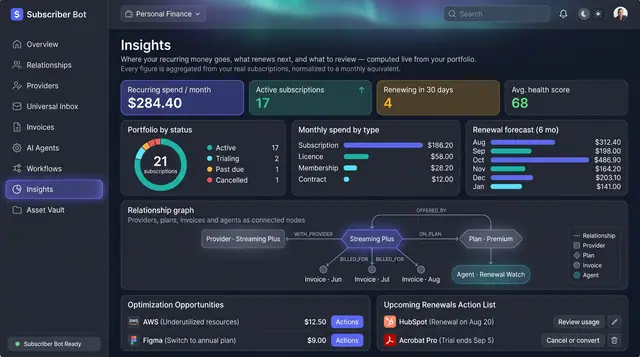
Portfolio Insights and Renewal Forecast
Recurring spend, portfolio health and the next six months of renewals, computed from your own subscriptions rather than typed in.
2 illustrations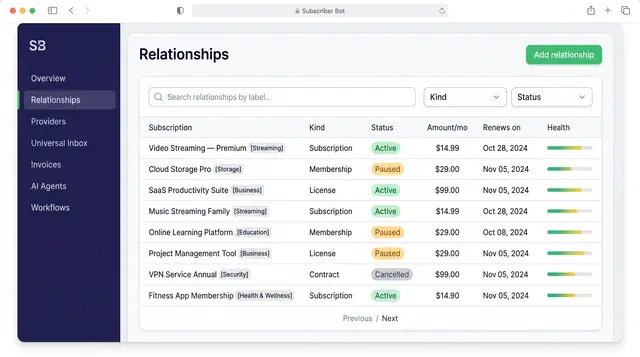
Subscription Relationships
Every subscription, membership, license and contract as one record with its plan, payment, entitlements, health and renewals.
3 illustrations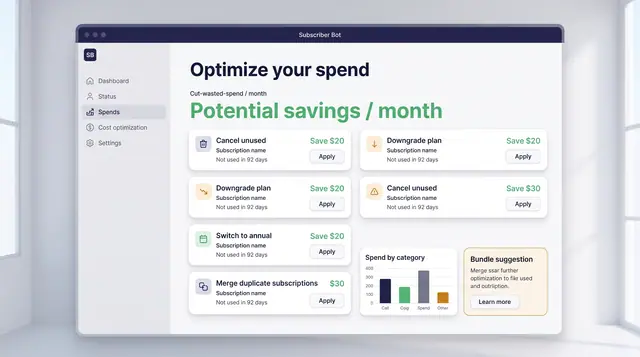
Spend Optimization and License Utilization
Turn portfolio data into decisions: cancel what is unused, downgrade what is oversized, and find the seats you are paying for twice.
2 illustrations
Part of an industry solution
This concept appears in a cross-product solution on burdenoff.com — see how it works alongside other Burdenoff products to solve a problem in that industry.