
SaaS Sprawl and Shadow IT: How Companies Lose Control of Subscription Spend
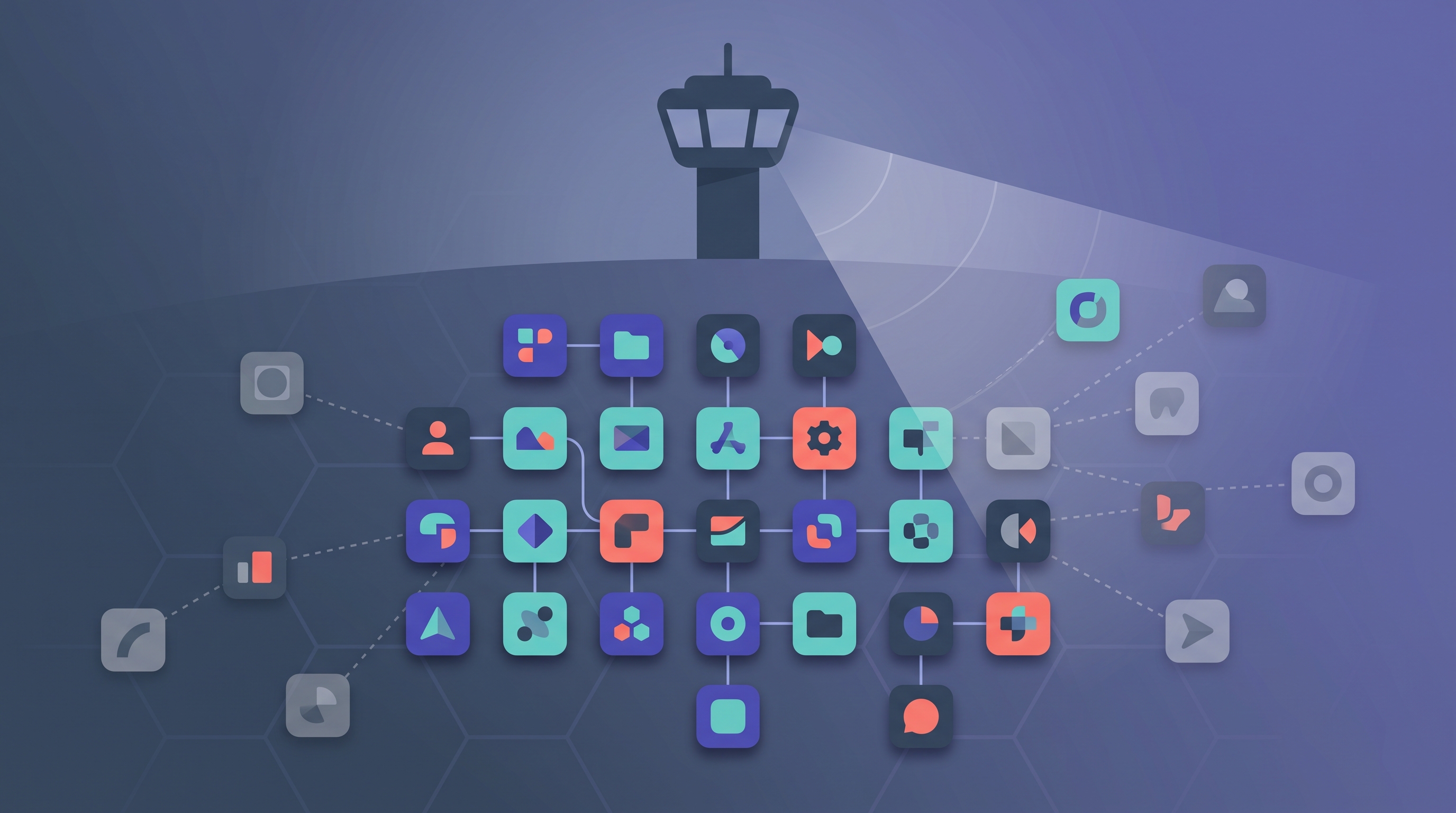
SaaS sprawl is what happens when a growing company ends up paying for far more software than anyone can account for. It creeps in one small purchase at a time, and by the time finance notices, dozens of unused or duplicate tools are quietly renewing every month.
What SaaS sprawl actually looks like
Every new SaaS tool starts the same way: someone on a team needs to solve a problem today, finds a tool that works, and signs up with a company card. No approval process, no record in a central system — just a fast, reasonable decision made under time pressure.
Multiply that decision across every team, every quarter, for a few years, and the numbers get large fast. Zylo's 2026 SaaS Management Index — based on the company's benchmarking of real customer software portfolios — found that the average organization now manages 305 SaaS applications and spends roughly $55.7 million a year on SaaS. Even for companies far smaller than that average, the underlying pattern holds: the software portfolio grows faster than anyone's ability to track it.
The issue isn't that any single purchase was a bad decision. It's that hundreds of small, individually reasonable decisions add up to a portfolio nobody has a complete view of.
Why shadow IT keeps growing
"Shadow IT" is the term for software running inside a company without IT's knowledge or approval. It isn't usually malicious — it's a team trying to move fast. But it has real consequences.
Research from Productiv, a SaaS management platform, has tracked this closely: in its analysis of customer application portfolios, Productiv found that shadow IT — apps not managed or owned by IT — made up 52% of the average company's application portfolio in 2020, growing to 56% by 2021. Separately, Productiv's State of SaaS research reports that around 48% of enterprise apps aren't actively managed at all, meaning no one is tracking renewal dates, licenses, usage, security posture, or compliance for them.
That matters for three concrete reasons:
- Unmanaged apps auto-renew. Nobody is watching the calendar, so contracts roll forward at full price even when usage has dropped to zero.
- Duplicate tools accumulate. Two teams solving the same problem independently often means two subscriptions for functionally the same tool.
- Compliance and security gaps widen. Software nobody approved is software nobody has reviewed for data handling, access control, or contractual risk — exactly the kind of exposure security and legal teams are supposed to catch before it becomes a problem.
The real costs: duplicate tools, idle licenses, missed deadlines
Three patterns show up over and over in unmanaged SaaS portfolios, and all three are addressable once there's visibility:
Idle licenses. A team buys 50 seats for a rollout, usage drops to 20 active users, and the renewal still bills for 50 — because nobody revisited the number. Multiplied across a large portfolio, unused seats are one of the most common sources of pure waste.
Overlapping tools. Two project-management tools, three AI writing assistants, a handful of overlapping analytics platforms — each individually justified, collectively redundant. Nobody set out to buy the same capability twice; it just happened gradually, tool by tool.
Missed contract deadlines. Auto-renewal clauses and notice periods are easy to miss when a contract lives in someone's inbox rather than a central system. A vendor with a 60-day notice-to-cancel window that nobody tracked can lock a company into another year of a tool it no longer wants.
To put a rough number on it: if even 10% of a company's software licenses sit idle at renewal — a conservative figure against the utilization rates independent SaaS research reports — that's a tenth of the entire SaaS budget spent on nothing at all, every single year, until someone catches it.
What a real SaaS spend control tower needs to do
Subscriber Bot's enterprise side is designed to address this by extending the same relationship model that powers its consumer product to the vendor and license level. A few capabilities the platform is being built around, directly aimed at the patterns above:
A single view of total spend and vendors. The Enterprise Control Tower is designed to summarize total SaaS spend, upcoming renewals, active vendors, and license utilization in one place, rather than scattered across procurement records, expense reports, and individual team owners.
Shadow IT and duplicate-vendor detection. A Risk Management Engine is intended to surface shadow IT, duplicate vendors, compliance violations, and vendor lock-in — the same categories that show up repeatedly in independent SaaS management research — so they can be addressed before renewal, not after.
Right-sized license tracking. Usage analytics are designed to answer the practical question finance and IT actually need answered at renewal time: who is actually using this, and how many of the seats we're paying for are idle?
Contract Intelligence. Rather than relying on someone to remember a notice period, Contract Intelligence is designed to read vendor contracts and extract renewal, auto-renewal, termination, SLA, and penalty terms — then alert the right owner with enough lead time to renegotiate, downsize, or cancel before a deadline becomes a liability. You can read more about how contract intelligence is meant to work.
Spend forecasting. Instead of discovering a renewal after it has already billed, the goal is a forward view of what's committed next month, next quarter, and next year — feeding directly into budget planning rather than surprising it. The fuller picture is on the SaaS spend management use case.
Governance you can trust with vendor and financial data
Any tool asking to see a company's full vendor and spend picture needs to earn that trust structurally, not just promise it. This part isn't aspirational — role-based access control, multi-tenant isolation, and an immutable audit log are part of the platform Subscriber Bot inherits and builds on for every workspace, so access to sensitive vendor and financial data is enforced at the permission level, and every action stays traceable. You can read the fuller picture on the security page.
That same governance layer is also what lets Subscriber Bot offer a genuinely usable free tier for individuals alongside enterprise-grade controls for organizations — one underlying platform, rather than a consumer app bolted onto enterprise software after the fact, or the reverse.
A starting checklist before you buy a SaaS management tool
Whether or not a dedicated platform is the next step, these are worth doing today:
- Pull every SaaS charge from the last 12 months across corporate cards and expense reports, not just centrally procured tools.
- Group by function, not by name — you'll likely spot two or three tools solving the same problem.
- Check usage, not just seats purchased, for the ten largest line items.
- List every contract's notice period and renewal date in one shared place, not individual inboxes.
- Assign an owner to each vendor relationship so a renewal decision isn't made by default.
FAQ
What is SaaS sprawl, in plain terms? It's the gradual, usually well-intentioned accumulation of software subscriptions across a growing organization until the total footprint exceeds what any one team or system can track — leading to duplicate tools, unused licenses, and renewals nobody reviewed.
What is shadow IT and why does it matter? Shadow IT is software being used inside a company without IT's knowledge or approval. It matters because unmanaged software is, by definition, software nobody has reviewed for renewal cost, actual usage, or security and compliance risk — and independent research consistently finds it makes up roughly half of the average company's application portfolio.
How is Subscriber Bot different from other SaaS management tools? Its core differentiator is a relationship lifecycle model that spans the same underlying platform from individual consumers through to enterprise vendor management, rather than two separate products. Enterprise governance — role-based access, audit logging, tenant isolation — is part of the platform for every workspace, and pricing is designed to include a transparent free tier alongside paid and enterprise plans, rather than a sales-only enterprise motion.
When will the enterprise features be available? Subscriber Bot is pre-launch and targeting a 2026 launch. Organizations interested in early access to the enterprise control tower and contract intelligence capabilities can join the waitlist or reach out directly ahead of general availability.
Do we need to rip out our existing procurement process to use this? No — the intent is for the control tower and contract intelligence to sit on top of how vendor relationships already get approved and purchased, giving finance, IT, and procurement a shared, continuously updated view rather than requiring a new approval workflow from scratch.
Get ahead of your next renewal cycle
SaaS sprawl doesn't announce itself — it shows up gradually, one reasonable purchase at a time, until a renewal audit turns up tools nobody remembers approving. The checklist above is a starting point you can run this week with a spreadsheet and your existing expense data.
Subscriber Bot's Enterprise Control Tower is being built to do that continuously instead of once a year. Join the waitlist to be notified as enterprise features roll out, or contact us to talk about early access for your organization.